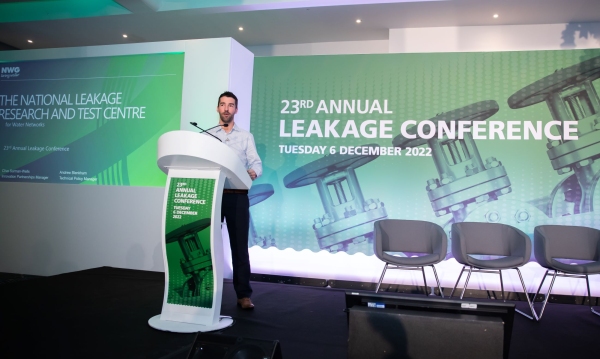
Work to develop the National Leakage Research and Test Centre (NLRTC) has been paused whilst financial commitment to the running of the facilities is confirmed.
The NLRTC is still very much needed: reducing leakage is an important challenge with 20% of potable water lost in the UK through distribution networks. At the centre, water companies and innovators will be able to test novel ways to find and fix leaks in a large, secure environment that replicates a real underground water network.
The consortium received funding in 2022 of £5,319,913 from Ofwat’s Water Breakthrough Challenge to develop the NLRTC. Partners in the consortium provided an additional 10% of funding.
To date, the consortium has completed phases 1, 2 and 3 of the project, including the design and planning of the NLRTC, spending £1,577,325.60. The work so far has included: assessing potential locations; drawing up the specification and designs in consultation with water companies and innovators; undertaking preparations to submit a full planning application; and inviting and assessing tenders from construction companies.
The consortium proposes building two facilities: an offline District Metered Area (DMA), and a smaller test rig, known as a sandpit. The DMA will be a fully scaled, buried water pipeline, with multiple sub-metered areas, leakage simulation bunkers, and a control room enabling automated control capabilities. The sandpit will allow water companies and innovators to try out new technology before testing it in the DMA. The sandpit and DMA will be constructed in HR Wallingford’s business park and neighbouring fields in Oxfordshire. Once built, the consortium intends that the centre will be operated by a partnership led by HR Wallingford.
Northumbrian Water Project Manager David Beckwith said: “To ensure the centre’s long-term viability, it’s essential that water companies contribute to the running costs of the centre – their commitment to it is vital before we move to the next stages of the project. Furthermore, since we secured the project funding in 2022, there have been inflationary pressures on construction costs. We worked with Stantec to optimise the detailed design to ensure cost efficiency while meeting the specification. Unfortunately, even with careful management, including an independent evaluation of construction bids and a reduction in design scope, the original funding is not sufficient to build the centre.”
The consortium has therefore returned the unused project funding of £3,888,406 to the Water Innovation Fund, and £396,156.10 to the partners in the consortium from their original contribution.
Andrew Brown, joint CEO of HR Wallingford, said: “We are still committed to constructing and running the centre, subject to gaining financial commitments from the water companies, and securing new funding to continue with the remaining planning activities and construction. We believe there is a real need for this centre, plus it aligns with our aim of helping people live and work sustainably with water.”
Marc Hannis, Principal, Ofwat Water Innovation Fund, said: “The National Leakage Research and Test Centre would be a valuable piece of enabling infrastructure for proving the safety and efficacy of new and untested solutions for leaks.
“Since Ofwat's Water Innovation Fund awarded funding in 2022, the NLRTC consortium of partners has made good progress in the planning and design phases, which have been delivered on time and on budget. However, with the cost of construction now higher than originally planned, Ofwat has agreed with the project and its partners that the money allocated to the construction phase will be returned to the Fund, and the project paused, while a new construction budget is agreed among the partners.
“Innovation is not straightforward and involves much trial, error and discovery. Sometimes it is necessary to pause and re-evaluate before taking further steps forward. The Water Innovation Fund has invited the NLRTC consortium to enter a future round of the Water Breakthrough Challenge innovation competition with a revised award request and new construction budget. As with all entries, any application will be assessed by an independent judging panel."